
Teaching and Learning Timeline

Teaching and Learning Timeline; capturing one school’s journey
Teaching and Learning at Alcester Academy - May 2026
Over the last three years, the Academy has made significant steps forward in terms of establishing a clear Teaching and Learning Framework. This is evidence informed with strategies implemented that are all inclusive and work specifically with our pupils and the context and demographic of our school.
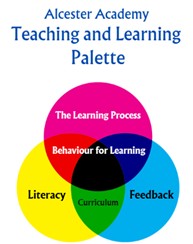
Our Teaching and Learning Palette comprises of 5 key areas:
- The Learning process
- Behaviour for learning
- Literacy (Reading, Writing and Oracy)
- Curriculum
- Feedback
The Learning Process
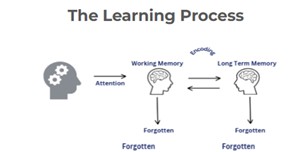
The learning process itself has been developed around the theory of ‘The Cognitive Load Theory’ (Sweller 1988) This is one of our key pedagogical approaches of successful teaching and learning at Alcester Academy. Both staff (through CPD) and pupils (through Personal Development) learn about the process of learning and how to apply this successfully in the classroom.
As a staff we all implement ‘The Five Focus’ which are five aspects of key pedagogy that consistently underpin all lessons:
- Establish a purposeful learning environment
- Determine Prior Knowledge
- Frequently check understanding of all learners
- Adapt teaching
- Provide opportunities to discuss learning
Questioning strategies also help to support and develop learner confidence in oracy with teachers supporting pupils by front loaded questions, posing pre-planned questions that are appropriately challenging, providing thinking time, targeted ‘cold call’ questioning (when appropriate), no opt out and praise- rewarding pupils for their participation and oracy skills.
Behaviour for Learning
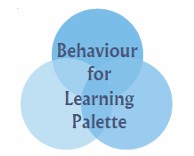
Behaviour for learning and teaching and learning interlink and one can’t function without the other.
At the Academy we have a culture where our school values are at the very core. Both pupils and staff are very clear about our high expectations in and outside of the classroom which include a consistent approach to behaviour for learning:
- Arrive on time
- Correct uniform
- Correct equipment
- Ready to learn
- Respect for staff and address in a formal manner
- Participate actively in your learning
- Respect for the learning environment
- Do not leave the classroom without permission
- An orderly exit
- Leave the classroom tidy and wait to be dismissed behind your chair
- Adhere to the school values at all times
By having a shared set of values, it enables us to work positively alongside one another with the behaviour for learning and teaching and learning palettes blending perfectly together.
Literacy
Literacy underpins the Academy’s curriculum by developing pupils’ abilities to speak, listen, read and write for a wide range of purposes, using language to learn through communicating, thinking, exploring and organising.
By helping pupils to express themselves clearly both orally and through their writing, we enhance and enrich teaching and learning across the curriculum.
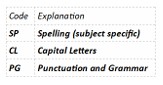
All teachers use our ‘Literacy 3’ approach when marking, with every exercise book and booklet displaying the following literacy codes for a consistent, whole school approach:
All teachers focus on subject-specific vocabulary (and spellings) at the start of each topic which support pupils’ knowledge and understanding of the curriculum within each subject area.
Curriculum
Education expert Mary Myatt is very clear that ‘curriculum development is an ongoing process’ and that ‘it’s not going to be finished- ever’ and we recognise that the curriculum is, and should be, the beating heart of ‘a school’s business.’
The curriculum intent is all the planning that happens before a teacher teaches the content (knowledge and skills).
The intent is very much the ‘substance of education’ and we have worked as a teaching team to establish clearly:
- What we want pupils to know
- How strong the curriculum is (especially in the ambitious years of KS3)
- Does the curriculum contain the right knowledge at the right time
- Is the curriculum providing pupils with the building blocks of what they need to know in order to succeed
It was important to us that the curriculum was not just a set of checklists to be ticked off. It was just about ensuring at all times that the curriculum offer was demanding and equitable for all pupils.
‘The implementation of the curriculum is the nuts and bolts of the quality of education. It is here that pupils encounter and grapple with the material. It is possible to have a website full of fine words and statements that the curriculum is ambitious, however, it is the quality of what happens in the classroom that indicates whether the intent has been translated into practice.’ Mary Myatt
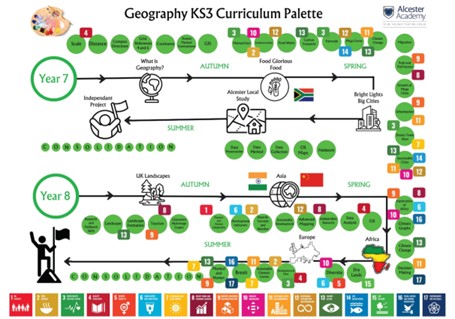
Our Curriculum Palettes have been very carefully designed and produced to ensure that all stakeholders are clear about the sequencing of each subject curriculum and shows a narrative of how each topic seamlessly blends into one another.
They are wonderful supportive visual tools that maps out each curriculum and its sequence and can be used to signpost areas for revision and topics that need to be covered due to absence, for pupils (and teachers) to pre-teach and research upcoming topics and to understand what skills are being developed and how it links to other subject areas.
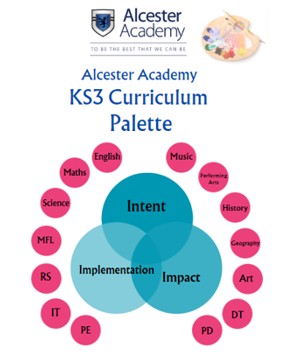
We have also begun to cross reference interdisciplinary links between subject areas, and a great piece of work is being developed to map out the United Nations Sustainability Development Goals directly alongside each subject curriculum:
Feedback
The DFE Teachers standards are very clear about how a teacher must make accurate and productive use of assessment:
- Know and understand how to assess the relevant subject and curriculum areas, including statutory assessment requirements
- Make use of formative and summative assessment to secure pupil’s progress
- Use relevant data to monitor progress, set targets, and plan subsequent lessons
- Give pupils regular feedback, both orally and through accurate marking, and encourage pupils to respond to feedback
The EEF (Education Endowment Foundation) also highlights that ‘providing feedback is well-evidenced and has a high impact on learning outcomes.
We know that different methods of feedback delivery can be effective and that feedback should not be limited exclusively to written marking. We encourage responsive feedback and an ‘up out of your seat’ approach at all times.
As a school, teachers have worked collaboratively to pilot and then implement and embed, feedback strategies that are evidence informed and work for our pupils and staff.
We have carefully considered how feedback will be received, including how it impacts on self-confidence and motivation. Teachers always provide opportunities for pupils to act upon feedback after it is given, evaluation how effective the feedback has been.
Our journey of implementation has been exciting and the benefits of which can be seen through not only pupil attainment and outcomes, but also in each individual personal development.
We are very proud of the Teaching and Learning Framework here at Alcester Academy, and appreciate, and are excited, that it will be an ever evolving cycle of renewal and development.
Miss McKenzie
In 2023, led by Miss McKenzie (SLT), the school further developed a teaching and learning pedagody around the ‘Five Focus’ areas. These are:
- Establish a purposeful learning environment (B4L)
- Determine prior knowledge
- Frequently check understanding of all learners (Questioning and Feedback)
- Adapt Teaching (including SEND)
- Provide opportunities to discuss learning (TPS)
The focus upon adaptive teaching has continued strongly into 2025-26 in a collaborative approach alongside The Three Rivers Alliance schools and we look forward to Sue Cowley speaking at our January 2026 Conference. Two lead members of the school are enrolled on the training for this with the Ambition Institute.
In 2023 a student team of T&L Ambassadors were created.
Spring 2020
The spring 2020 saw the exciting arrival of a new Director of Studies, Mrs Woodman (SLT) overseeing the Quality of Education and Assessment. During this period, curriculum overviews were finalised for all subject areas and published for parents to see on our website. This helped to close the loop with parental feedback where many parents had said that they could support children better if they had a greater understanding of what was being taught and how it was assessed. In response to questions raised about the length of curriculum, the school participated in the NFER project around whether KS4 should be a 2 or 3 year programme. This is in conjunction with the Education Endowment Trust. The science team are also running pilot assessments with the EEF for year 9 students. We are excited to see the outcome of both pieces of research. Work towards developing school reports has also begun and we are launching some pilot ‘new look’ reports in the summer in order to gain parental feedback. Thank you to parents who provided this in advance of our developments.
Autumn 2019
All staff will be Level 1 TEEP trained by December 2019 and we are looking forward to a Presentation Evening hosted by Corinne Settle of the SSAT in order to celebrate the huge amount of work completed with this.
Subject Leaders are looking forward to working alongside Educational Consultant, David Turner once more. David will be completing some development work with Middle Leaders and Governors around the new Ofsted Framework.
Tom Walton, Lead Inspector for Ofsted will also be coming in to talk to the whole staff about the new Framework.
Long term plans and curriculum over views have been updated. These are available on the school website.
Our work around metacognition and improving outcomes for boys continues.
Spring 2019
- Work around TEEP continues across the teaching staff with the continued sharing of good practice through CPD. This has consisted of AfL sessions and IT sessions led by various individuals. TEEP 'families' have been revised and co observations have been established.
- Teachers have successfully used the 'new look' TEEP lesson plan to aid their work around this pedagogy.
- Miss Cotterill has successfully been granted TEEP Level 3 and is now recognised to be able to train other colleagues.
- The Academy welcomed Corinne Settle from the SSAT in order to plan next steps with TEEP.
- Training for Metacognition continues and one key staff member is working towards this at Shirelands Research School.
- Academy staff have benefitted from updated Click View training as a superb classroom resource.
- Further work with primary colleagues continues in the areas of English, maths and inclusion.
- The Academy continues to be involved with the Shires teaching School.
- 'Live' monitoring, evaluation and review has continued and is being developed through joint subject learning walks; SLT link with Subject Leader.
- Learning Walks for literacy have taken place.
- Several subject areas have been supporting CW10 links and have supported network meetings.
- Plans are in place for revisiting Curriculum plans in readiness for the new Inspection Framework September 2019. This includes a focus upon wider reading.
- A new draft Feedback Policy has been launched as a result of student feedback, staff action research and a response to national teacher workload pressures.
- Ofsted visited. March 2019.
Autumn 2018
TEEP training (Year 2) has begun as follows:
- Training took place on the first day back for all teaching staff to review last academic year’s progress and look at metacognition (see June updates for Governors).
- Teaching staff were issued with quality TEEP resources that can be adapted in their own lessons
- New TEEP families were assembled in order to refresh the approach in Year 2.
- There is a new focus on co-observation to develop staff further in the area of metacognition. This has to be completed this term.
- All teaching staff have been asked to complete a lesson plan using the new TEEP template.
- Hayley Farnell has joined the planning and delivery team. She is L3 TEEP trained.
- There will be further work with student learning ambassadors in order to begin to measure the impact of these initiatives on the learners in school.
- The CPD schedule for 2018-19 is largely based around T and L updates in the areas of TEEP, metacognition, questioning, quizzing and action research.
Appraisal 2018-19 has been launched. Teaching staff continue to have three objectives set around student progress and TEEP development. There is a new emphasis this year on ‘action research’ for the third objective and staff have the option to complete a project, or focus on a personalised area linked to their role in school. All UPS 3 staff continue to have a fourth objective based round their whole school responsibility.
There is a greater drive around setting ‘Quizzing’ as homework in the lower school:
Quizzing is designed to help develop the skills needed to be an effective learner. It is an effective revision strategy; it instructs students how to chunk, memorize and recall key elements of learning. This method is extremely useful especially as the new GCSE specifications require an even stronger command of subject-knowledge. Quizzing means that students can revise and master information at home. By ensuring that information is memorized over a longer period of time, rather than in an intense revision session just before an exam, students are developing your ability to retain and effectively recall the knowledge you need to pass exams. Cramming is not an effective tool and it can lead to increased anxiety. Quizzing will hugely reduce the pressure of exams as learning is spread over the years. This method of revision is commonly used by university students as it has proven to be the most beneficial.
The Academy welcomes two new staff to the English teaching team; Miss Watton and Miss Hammond. Both members of staff are strong additions to the team. Miss Elliott is now Leader of Maths after Mr Seager adopted a part time role in order to focus more time on Just Maths https://online.justmaths.co.uk/
Miss Bartlett begins a new role within the English team as a higher level teaching assistant with some additional support from Mrs Hands (Librarian). This extra support has helped to map out essential interventions within this core subject.
Key subject staff have been made available to provide intervention for Year 11 students in their core PE lessons.
Miss Wincup continues to have additional responsibility in the area of developing strategies for boys. Presently, she is working on an action research project with several groups.
The academy continues to support avid reading and this is tracked via the Renaissance Accelerated Reader Programme https://www.renaissance.com/products/practice/accelerated-reader-360/
The Humanities teaching team have made a physical transition to the top floor of the tower over the summer. Classrooms are looking vibrant and the staff have embraced these changes very positively.
Several members of staff led some training for others on ‘Mindfulness’ at the end of the summer term. This was received very well indeed and will be developed in future months.
Teaching and Learning Updates 2016-17
Teaching and Learning Updates 2015-16
Teaching and Learning Updates 2013-15